 |
 |
| Misterious vase detail with giant horse, serie of Gammadian swastika and women around there is water pouring between each fem and swastikas. |
 |
 |
| above -This relief shows battle of men and women. bellow - seated Queen with Griphon and probably guards. |
 |
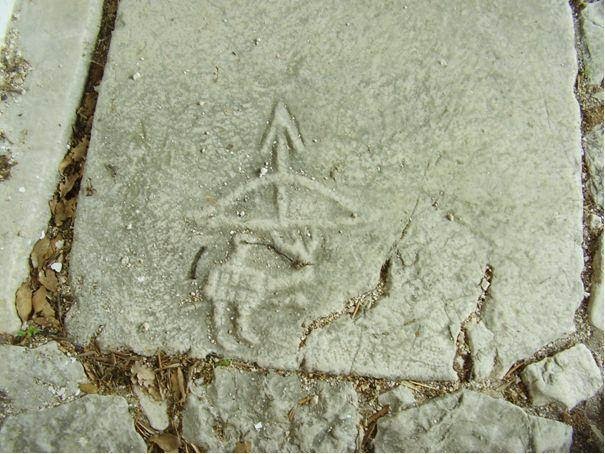
| Dardanian labyrinth, Dea Dardanica |

 |
| Daorson, Bosnia, Illyria |
 |
| Kleitia Lusand Haire Illyria, Durres |
 |
| Slace, Centurion, Narona ,Illyrians this drawing is product of sexual imagination of a male. |
http://en.wikipedia.org/wiki/Ballaios
It looks like those that cover things up are too busy covering up so they need extra fingers for some loose ends. Tracing of Troja have been very difficult for over 3000 years because one day it is up North on Baltic, then it goes to Uk and finnaly it settled in Turkey. But hey, you can't fidgit forever, truth have very painfull way of surfacing back up. In these 2 wiki links discord between countries and languges is absolutely ridiculous. I was looking for Mysia or Moesia which was settled across todays Bulgaria and Romania, Troad as Troja is today in Bosna, Lycia in Croatia and Thrace/Thrakia in Bulgaria and Romania instead of todays Turkey.I just had to post this stupidity and copy entire Wiki link cause they are champions in re-writting His-story or even maybe dis-Troy previous His-Story...!!!
 |
| Mysia Ancient Region of Anatolia |
 |
| Paleo-Balkan languages |
from Wiki; http://en.wikipedia.org/wiki/Mysia
Mysia
From Wikipedia, the free encyclopedia
For other uses, see Mysia (disambiguation).
| Mysia | |
|---|---|
| Ancient Region of Anatolia | |
| Location | North-western Anatolia |
| Largest city | Pergamon |
| Roman province | Asia |
 | |
Mysia (/ˈmɪʒə/ or /ˈmiːʒə/; Greek: Μυσία, Latin: Mysia) was a region in the northwest of ancient Asia Minor or Anatolia (part of modern Turkey). It was located on the south coast of theSea of Marmara. It was bounded by Bithynia on the east, Phrygia on the southeast, Lydia on the south, Aeolis on the southwest, Troad on the west and by the Propontis on the north. In ancient times it was inhabited by the Mysians, Phrygians, Aeolian Greeks, and other groups.
Contents
[hide]Geography
The precise limits of Mysia are difficult to assign. The Phrygian frontier was fluctuating, while in the northwest the Troad was only sometimes included in Mysia. The northern portion was known as Lesser Phrygia or Phrygia Minor (Ancient Greek: μικρὰ Φρυγία), while the southern was called Major or Pergamene. Mysia was in later times also known as Phrygia Hellespontica(Ἑλλησποντιακὴ Φρυγία, "Hellespontine Phrygia") or Phrygia Epictetus (ἐπίκτητος Φρυγία, "acquired Phrygia"), so named by the Attalids when they annexed the region to the Kingdom of Pergamon.[1]
Land and elevation

The chief physical features of Mysia are the two mountains—Mount Olympus at (7600 ft) in the north and Mount Temnus in the south, which for some distance separates Mysia from Lydia and is afterwards prolonged through Mysia to the neighbourhood of the Gulf of Adramyttium. The major rivers in the northern part of the province are the Macestus and its tributary the Rhyndacus, both of which rise in Phrygia and, after diverging widely through Mysia, unite their waters below the lake of Apolloniatis about 15 miles (24 km) from the Propontis. The Caïcus in the south rises in Temnus, and from thence flows westward to the Aegean Sea, passing within a few miles of Pergamon. In the northern portion of the province are two considerable lakes, Artynia or Apolloniatis (Abulliont Geul) and Aphnitis (Maniyas Geul), which discharge their waters into the Macestus from the east and west respectively.
Cities in Mysia
The most important cities were Pergamon in the valley of the Caïcus, and Cyzicus on the Propontis. The whole sea-coast was studded with Greek towns, several of which were places of considerable importance; thus the northern portion included Parium, Lampsacus and Abydos, and the southern Assos,Adramyttium. Further south, on the Eleatic Gulf, were Elaea, Myrina and Cyme.
History
A minor episode in the Trojan War cycle in Greek mythology has the Greek fleet land at Mysia, mistaking it for Troy. Achilles wounds their king,Telephus, after he slays a Greek; Telephus later pleads with Achilles to heal the wound. This coastal region ruled by Telephus is alternatively named Teuthrania in Greek mythology, and was previously ruled by a King Teuthras. In the Iliad, Homer represents the Mysians as allies of Troy, with the Mysian forces led by Ennomus (a prophet) and Chromius, sons of Arsinous. Homeric Mysia appears to have been much smaller in extent than historical Mysia, and did not extend north to the Hellespont or the Propontis. Homer does not mention any cities or landmarks in Mysia, and it is not clear exactly where Homeric Mysia was situated, although it was probably located somewhere between the Troad (to the northwest of Mysia) and Lydia/Maeonia (to its south).
There are a number of Mysian inscriptions in a dialect of the Phrygian language, in a variant of the Phrygian alphabet. There are also a small number of references to a Lutescan language indigenous to Mysia in Aeolic Greek sources.[2]
Ancient bridges
The remains of several Roman bridges can still be found:
- Aesepus Bridge across the Aesepus (Gönen Çayı)
- Constantine's Bridge across the Rhyndacus (Adırnas Çayı)
- Makestos Bridge across the Makestos (Susurluk Çayı)
- White Bridge across the Granicus (Biga Çayı)
See also
References
This article incorporates text from a publication now in the public domain: Chisholm, Hugh, ed. (1911). Encyclopædia Britannica (11th ed.). Cambridge University Press.

from Wiki; http://en.wikipedia.org/wiki/Paleo_Balkan_languages
Paleo-Balkan languages
From Wikipedia, the free encyclopedia
(Redirected from Paleo Balkan languages)
| Part of a series on |
| Indo-European topics |
|---|
 |
Paleo-Balkan is a geolinguistic term referring to the Indo-European languages that were spoken in theBalkans in ancient times. Except for Greek and the language that developed into Albanian, they are all extinct,[1] due to Hellenization, Romanization, Slavicization and Turkicization.
Contents
[hide]Classification
The following languages are reported to have been spoken on the Balkan Peninsula by Ancient Greek and Roman writers:
- Ancient Macedonian
- Dacian
- Illyrian
- Liburnian
- Messapic
- Mysian
- Paeonian
- Phrygian
- Thracian
- Venetic
- Proto-Greek
- Pelasgian
Although these languages are all members of the Indo-European language family, the relationships between them are unknown. Classification of the languages spoken in the region is severely hampered by the fact that they are all scantily attested. Furthermore, many of the individuals who have published studies on these languages have had strong patriotic or nationalistic interests, which compromises the scholarly value of their work.
Subgrouping hypotheses
Illyrian is a group of reputedly Indo-European languages whose relationship to other Indo-European languages as well as to the languages of the Paleo-Balkan group, many of which might be off-shoots of Illyrian, is poorly understood due to the paucity of data and is still being examined. The Illyrian languages are often considered to be Centum dialects.[2] Today, the main source of authoritative information about the Illyrian language consists of a handful of Illyrian words cited in classical sources, and numerous examples of Illyrian anthroponyms, ethnonyms, toponyms andhydronyms.
A grouping of Illyrian with Messapian has been proposed for about a century, but remains an unproven hypothesis. The theory is based on classical sources, archaeology, as well as onomastic considerations. Messapian material culture bears a number of similarities to Illyrian material culture. Some Messapian anthroponyms have close Illyrian equivalents.
A grouping of Illyrian with Venetic and Liburnian, once spoken in northeastern Italy and Liburnia respectively, is also proposed. The consensus now is that Illyrian was quite distinct from Venetic and Liburnian,[3][4] however a close linguistic relation has not been ruled out and is still being investigated.
Another hypothesis would group Illyrian with Dacian and Thracian into a Thraco-Illyrian branch,[5] whereas a competing hypothesis would exclude Illyrian from a Daco-Thracian grouping in favor of Mysian.[6] The classification of Thracian itself is a matter of contention and uncertainty.
The place of Paeonian remains unclear.[7] Not much has been determined in the study of Paeonian, and some linguists do not recognize a Paeonian area separate from Illyrian or Thracian. The classification of Ancient Macedonian and its relationship to Greek are also under investigation, with solid sources pointing that Ancient Macedonian is in fact a variation of Doric Greek, but also the possibility of being only related through the local sprachbund.[8][9][10][11][12]
Phrygian, on the other hand, is considered to have been most likely closely related to Greek.[13][14]
Albanian
The Albanian language is considered by current linguistic consensus to have developed from one of the non-Greek, ancient Indo-European languages of the region, but attempts to connect it to a specific language have been fruitless (see Origin of the Albanians).[15]
References
- ^ Simmons, Austin; Jonathan Slocum. "Indo-European Languages: Balkan Group: Albanian". Linguistics Research Center of the University of Texas at Austin. Retrieved 8 September 2012.
- ^ A Grammar of Modern Indo-European by Carlos Quiles,ISBN 8461176391,2007, page 77,"The Illyrian languages are generally but not unanimously reckoned as centum dialects"
- ^ Wilkes, J. J. The Illyrians, 1992,ISBN 0631198075,page 183,"... We may begin with the Venetic peoples, Veneti, Carni, Histri and Liburni, whose language set them apart from the rest of the Illyrians. ..."
- ^ Wilkes, J. J. The Illyrians, 1992,ISBN 0631198075,page 81,"... " In Roman Pannonia the Latobici and Varciani who dwelt east of the Venetic Catari in the upper Sava valley were Celtic but the Colapiani of the Colapis (Kulpa) valley were Illyrians ( ... )"
- ^ Cf. Paglia, Sorin (2002),"Pre-Slavic and Pre-Romance Place-Names in Southeast Europe." 'Proceedings of the 8th International Congress of Thracology', Sofia, Bulgarian Institute of Thracology – Europa Antiqua Foundation - Bulgarian Academy of Sciences, I, 219–229, who states: "According to the available data, we may surmise that Thracian and Illyrian were mutually understandable, e.g. like Czech and Slovak, in one extreme, or like Spanish and Portuguese, at the other."
- ^ Vladimir Georgiev (1960), Raporturile dintre limbile dacă, tracă şi frigiană, "Studii Clasice" Journal, II, 1960, 39-58.
- ^ Paeonia
- ^ Paliga (2002) states: "It is therefore difficult to say whether the ancient Macedonians spoke an idiom closer to Thracian, Illyrian, Greek or a specific idiom."
- ^ Masson, Olivier (2003) [1996]. "[Ancient] Macedonian language". In Hornblower, S. and Spawforth A. (eds.). The Oxford Classical Dictionary (revised 3rd ed. ed.). USA: Oxford University Press. pp. 905–906. ISBN 0-19-860641-9.
- ^ Hammond, N.G.L (1993) [1989]. The Macedonian State. Origins, Institutions and History (reprint ed. ed.). USA: Oxford University Press. ISBN 0-19-814927-1.
- ^ Michael Meier-Brügger, Indo-European linguistics, Walter de Gruyter, 2003, p.28,on Google books
- ^ Roisman, Worthington, 2010, "A Companion to Ancient Macedonia", Chapter 5: Johannes Engels, "Macedonians and Greeks", p. 95:"This (i.e. Pella curse tablet) has been judged to be the most important ancient testimony to substantiate that Macedonian was a north-western Greek and mainly a Doric dialect".
- ^ Brixhe, Cl. "Le Phrygien". In Fr. Bader (ed.), Langues indo-européennes, pp. 165-178, Paris: CNRS Editions.
- ^ Woodard, Roger D. The Ancient Languages of Asia Minor. Cambridge University Press, 2008, ISBN 0-521-68496-X, p. 72. "Unquestionably, however, Phrygian is most closely linked with Greek."
- ^ Alföldy, Geza (1964). "Die Namengebung der Urbevölkerung in der römischen Provinz Dalmatia." (Heidelberge) Beiträge zur Namenforschung 15.55-104; Duridanov, Ivan (1976). Ezikyt na trakite. Sofia: Nauka i izkustvo; Hamp, Eric P. (1957). "Albanian and Messapic." Studies Presented to Joshua Whatmough 73-89. La Haye: Mouton; Hamp, Eric P. (1966). "The position of Albanian." In: Birnbaum, Henrik & Jaan Puhvel (1966). Ancient Indo-European dialects: proceedings. Berkeley: University of California Press; Katičić, Radoslav (1964). "Namengebiete im römischen Dalmatian." Die Sprache 10.23-33; Katičić, Radoslav (1976).Ancient Languages of the Balkans. La Haye: Mouton, 2 vol; Krahe, Hans (1925). Die alten balkanillyrischen geographischen Namen. Heidelberg; Winter; Hans Krahe|Krahe, Hans (1929) Lexikon altillyrischen Personennamen. Heidelberg: Winter; Krahe, Hans (1955). Die Sprache der Illyrier, vol. 1. Wiesbaden: Winter; Kronasser, Heinz (1962). "Zum Stand der Illyristik." Linguistique Balkanique, 4:5-23; Kronasser, Heinz (1965). "Illyrer und Illyricum." Die Sprache 11.155-183; Neroznak, Vladimir Petrovich (1978). Paleobalkanskie jazyki. Moskva: Nauka; Paliga, Sorin (2002). "Pre-Slavic and Pre-Romance Place-Names in Southeast Europe." Proceedings of the Eighth International Congress of Thracology. Sofia: Bulgarian Academy of Sciences, vol. 1, pp. 219–229; version intégrale: Orpheus11–12.85–132; Pollo, Stefan & Alex Buda (1969). Historia e popullit shqiptar. Prishtina, 2 vols.; Pollo, Stefan & Arben Puto (1974). Histoire de l’Albanie: des origines à nos jours. Lyon: Horvath; Polomé, Edgar C. (1982). "Balkan Languages: Illyrian, Thracian and Daco-Moesian." In: Boardman, Edwards et al. (1982). The Prehistory of the Balkans; and the Middle East and the Aegean world, tenth to eighth centuries B.C. London: Cambridge University Press, The Cambridge Ancient History, 2nd ed., vol. 3, part 1, pp. 866-888; Schwandner-Sievers, Stéphanie et al. (2002). Albanian identities: Myth and history. Bloomington: Indiana University Press. Chapitres notamment par Noel Malcolm, George Schöpflin et Ger Duijzings; Simone, Carlo de (1964). Die messapischen Inschriften und ihre Chronologie. Wiesbaden: Harrassowitz ('Die Sprache der Illyrier, vol. II); Rădulescu, Mircea-Mihai (1984). "Illyrian, Thracian, Daco-Mysian, the substratum of Romanian and Albanian." Journal of Indo-European Studies 12.77-131; Rădulescu, Mircea-Mihai (1987). "The Indo-European position of Illyrian, Daco-Mysian and Thracian: A historica-methodological approach." Journal of Indo-European Studies 15.239-271; Rădulescu, Mircea-Mihai (1994). "The Indo-European position of Messapic."Journal of Indo-European Studies 22.329-344; Untermann, Jürgen (1964). Die messapischen Personennamen. Wiesbaden: Harrassowitz (Die Sprache der Illyrier, vol. II); Untermann, Jürgen (2001). Die vorrömischen Sprachen der iberischen Halbinsel: Wege und Aporien bei ihrer Entzifferung. Wiesbaden: Westdt. Verlag; Watkins, Calvert (1998). "The Indo-European linguistic family: genetic and typological perspectives". In: Giacalone Ramat, Anna & Paolo Ramat, eds (1998). The Indo-European languages. London: Routledge; Wilkes, John (1992). The Peoples of Europe: The Illyrians. Oxford: Blackwell Publishers.
Bibliography
- Crossland, R.A.; Boardman, John (1982). "Linguistic problems of the Balkan area in the late prehistoric and early Classical period" in The Cambridge Ancient History Volume 3, Part 1. Cambridge University Press. ISBN 978-0-521-22496-3.
- Polomé, Edgar Charles (1982). "Balkan Languages (Illyrian, Thracian and Daco-Moesian)". Cambridge Ancient History. III.1. pp. 866–888.
- Harmatta, János (1967). "Zum Illyrischen". Acta Antiqua Academiae Scientiarum Hungaricae 15: 231–234.
- Krahe, Hans (1929). Lexikon altillyrischen Personennamen. Heidelberg.
- Krahe, Hans (1950). "Das Venetische: seine Stellung im Kreise der verwandten Sprachen". Sitzungsberichte der Heidelberger Akademie der Wissenschaften, Philosophisch-Historische Klasse 3: 1–37.
- Tovar, Antonio (1977). Krahes alteuropäische Hydronymie und die westindogermanischen Sprache. Winter. ISBN 3-533-02586-1.


